What is anti-mould fogging and does it work?
People see the machine come out of the van and assume it's a gimmick, so let us explain what it's for. When you wipe a wall, you treat the wall. You don't treat the carpet, the curtains, the back of the wardrobe or the air in the room, and that's where a lot of the spores can be found.
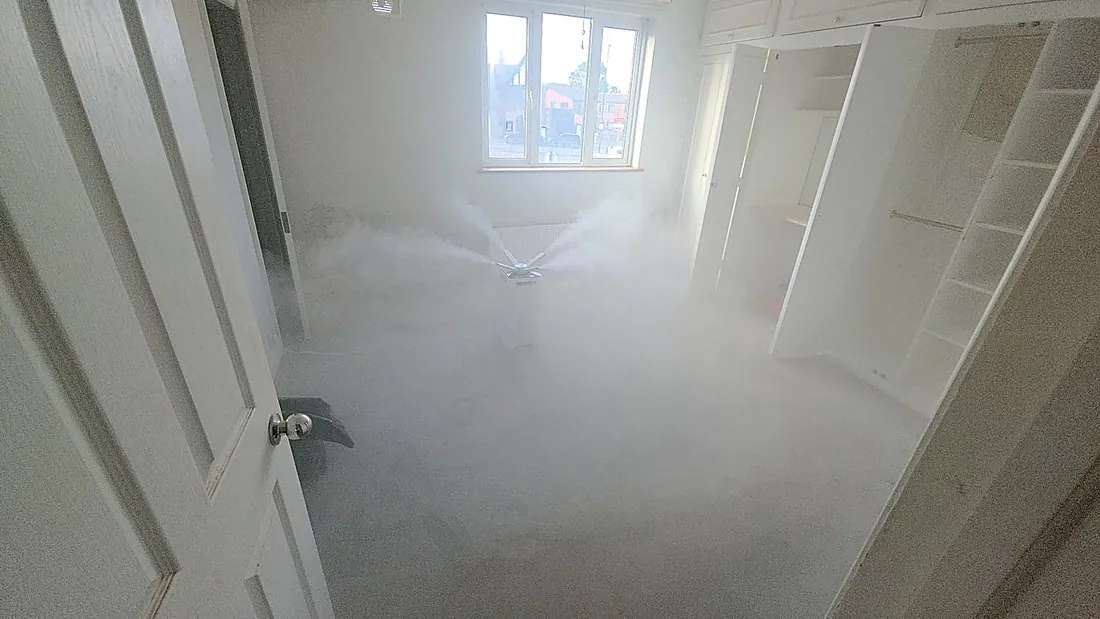
Anti-mould fogging creates a mist fine enough to settle on every surface in a room, including carpet, curtains and the back of a wardrobe where spores have already spread. It's highly effective as part of a complete solution. Manual cleaning is still required for the heavy growth.
Mould doesn't stay on the wall
This is the bit that surprises people. What you can see on the wall is the growth. The spores are airborne, they're microscopic and by the time you've noticed the black patch they're all over that room. They settle into carpet and underlay, into soft furnishings, on top of the skirting, inside the wardrobe, behind the headboard. So you can clean that wall beautifully and still have a room full of spores waiting to land back on it the moment the conditions suit. That's a big part of why the same patch keeps reappearing.
How does anti-mould fogging actually work?
The machine turns an anti-mould product into a very fine mist, fine enough that it behaves more like smoke than a spray. It fills the room and settles on everything, including all the surfaces you'd never get a cloth anywhere near. It dries off on its own and doesn't need wiping down afterwards. Nothing gets soaked, nothing drips and nothing is left wet the way a spray bottle leaves it. It also takes a fraction of the time it would take to hand treat a whole room properly.
We use it as well as, not instead of
If there's heavy black growth on a wall, fogging alone is not the answer and we're not going to pretend it is. The visible mould comes off physically first, the surface underneath gets treated, and then we fog the room to deal with everything that has already spread beyond the wall. Doing the second part without the first is cosmetic and it'll look wrong. Doing the first without the second is why people find it back in the same room a few months later and can't work out how.
Is fogging safe around kids and pets?
Everybody out of the room while it's being done, animals included, and the room stays shut for a while afterwards so it can settle and dry. Once it's dry it's safe to use normally, and we'll tell you exactly how long for your room, because it varies with size and ventilation. There's a faint smell for a few hours that clears as it goes off. You don't need to empty the room either, which is rather the point. The fog gets behind and under things, which is where the issue is hiding.
Why a room full of spores is worth taking seriously
Because you're breathing that room in every night. NHS guidance links damp and mould with respiratory issues, asthma attacks, wheezing, coughing and infections, and says the risk is higher for babies, children, older people and anyone with asthma, eczema or a weakened immune system. That's why we'll push for fogging in a bedroom or a nursery and tell you not to bother in a downstairs loo. It isn't about the black on the wall by that point, it's about everything that's already come off it. If somebody at home has been coughing all winter, get the room done properly and have a word with your GP as well. Those are two separate jobs and one doesn't replace the other.
When it's not worth doing
If you've got one small patch of mould on the silicone round the shower, fogging the whole bathroom is overkill and we'd tell you that on the phone rather than take the booking. Where it earns its money is where mould has been in a room a long time, where it's in a bedroom somebody sleeps in, where there's carpet and soft furnishings involved, or after a leak when nobody knows how far it has travelled. Those are the jobs across Surrey you cannot clean your way out of with a cloth and a spray bottle.
Common questions
Does it stain or mark anything?
It shouldn't. The mist is very fine and it dries clear, so curtains, carpets and painted walls come out looking the same as they went in. We still cover or move anything precious before we start, and we'll always tell you if something in that room wants treating carefully rather than just fogged with everything else.
How long does a room take?
The fogging itself is quick, usually well under an hour for a normal sized room. The waiting afterwards is the longer part and that depends on the room and how well it ventilates. On a full job we'd do the physical removal and the treatment first, so the fogging tends to be the last thing we do before we tidy up and get out of your way.
Will one fogging sort it for good?
Not on its own, no. Fogging clears what has spread through the room. If the wall is still cold and the air is still damp, it will grow again, because nothing about the cause has changed. It's one part of the job, and an important one. The ventilation is the part that decides whether it stays gone.