Is it condensation, a leak or rising damp? How to tell
This is the one we get asked more than anything else, and it matters, because the three need completely different work doing. Condensation is an air issue. Rising damp and leaks are building issues, and here's how you tell them apart before anyone comes near you with a quote.
Condensation sits high up, in corners, on windows and behind furniture, and it eases off in summer. Rising damp starts at the skirting, climbs no higher than about a metre and leaves a tide mark and white salting. A leak stays in one spot all year round. Height and season tell you which one you've got.
Start with where it sits on the wall
Height tells us most of it. Rising damp comes up out of the ground, so it starts at the skirting and climbs, and it rarely gets much above a metre. You'll often see a tide mark where it stops. Condensation mould does the opposite. It sits in the top corners of the room, on the ceiling, on window reveals, behind the wardrobe on the outside wall, anywhere the air is still and the surface is cold. A leak is different again. It tends to be one defined patch, often with a run mark, sat wherever the water is actually getting in. If yours is high up and in the corners, you can stop worrying about your damp course.
Does it come and go with the seasons?
Condensation is a winter issue. It turns up when the heating goes on and the windows stay shut, and it quietens down in spring. Rising damp and penetrating damp don't care what month it is. They're there all year, they just look worse after a wet spell. So if that wall was fine all summer and it's back now the clocks have gone back, you're looking at air, not the building. If it's been the same patch since June, we'd be looking outside for water getting in.
Look at your windows before you open the curtains
Water running down the glass and puddling on the sill in the morning is the clearest condensation sign there is. Here's the part people miss. If it's landing on the glass, it's landing on every other cold surface in that house as well. The window is just the only place you can actually see it happening. So if you're wiping sills every morning, the black in the bedroom corner and the mould behind the chest of drawers are coming from the same place. It's one issue, not three.
Is it salting? Check for the white powdery stuff
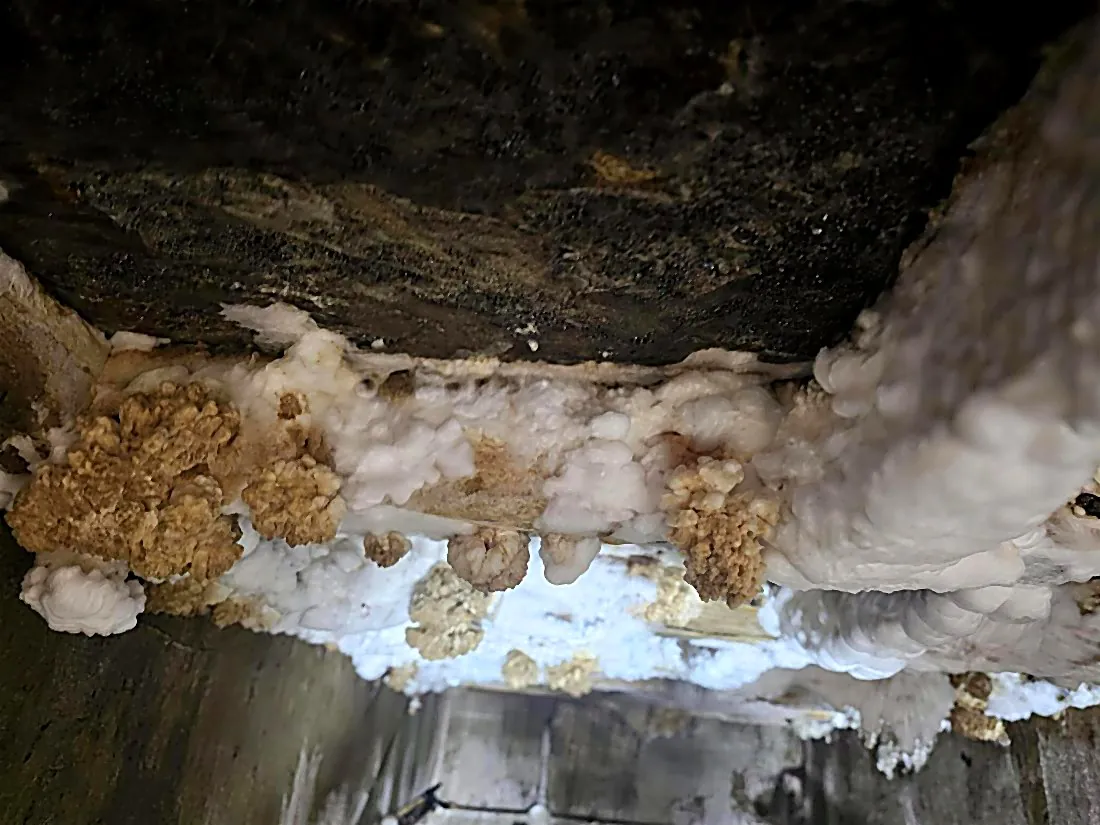
If there's a chalky white bloom coming through the paint, or the plaster has blown and crumbles when you press it, that's salts. Ground water carries them up through the brickwork and leaves them behind when it evaporates out. Condensation does not do that. Salting is a proper damp signal and it usually means that wall has to come back to brick, get a damp-proof course put in and be re-rendered. That's the biggest job we do and we'd rather you knew that now than found out halfway through.
Then go outside and look up
Half the jobs people call rising damp aren't. Go out with an umbrella next time it's raining hard and look at the wall from outside. Is a gutter overflowing down it. Is a downpipe blocked or split at the back where you can't see. Has somebody laid a patio or built a flowerbed up above the damp course so water bridges straight past it. Is the pointing blown. Around Esher, Cobham and Weybridge we've fixed more so-called rising damp with a gutter clear and a lowered flowerbed than with anything injected into a wall.
What does it cost you to get this wrong?
More than the survey would have. Treat condensation as rising damp and you pay for a damp-proof course you never needed, and the mould is back the following winter because nothing about the air has changed. Treat rising damp as condensation and the water keeps coming. Damp left in a wall for years rots skirtings, gets into joists and window frames and ruins plaster, which is how a job goes from hundreds to thousands. It also gets flagged on a homebuyer survey later, and buyers renegotiate or walk over the word damp. And plenty of houses genuinely have two of these at once, because a damp wall is a cold wall and a cold wall pulls condensation onto it. That's why we survey before we quote instead of pricing off a photo somebody has sent us.
Common questions
Does rising damp actually exist, or is it a myth?
It exists. It's just diagnosed far more often than it happens, usually by people who sell damp courses. In a lot of the houses we go to, what's been called rising damp is a leaking gutter, a bridged damp course or a bit of blown render. Get it properly diagnosed before anyone injects anything into your walls.
Can I test it myself with a damp meter?
You can buy one, but the cheap ones only read the surface, and salts in a wall throw them completely. They'll happily tell you a dry salty wall is soaking wet. They're a rough guide at best and they've caused a lot of unnecessary work over the years. Do the checks above first. They'll tell you more than a cheap meter will.
What if I'm still not sure which one it is?
Send a photo. Get the whole wall in, floor to ceiling, and tell us whether it's worse in winter. Between the picture and two or three questions we can usually tell you over the phone which of the three you're dealing with, and whether you need anybody out at all. We're on 01372 271248, every day, 8am to 8pm.